Intro to the Human Body
- BIOL235 - Exercises
- 1.1. Anatomy and Physiology Defined, p. 16
- define anatomy and physiology.
- Anatomy
- the science of body structures and the relationships among them
- branches include embryology, developmental biology, cell biology, histology, gross anatomy, systemic anatomy, regional anatomy, surface anatomy, radiographic anatomy, pathological anatomy
- Dissection (careful cutting apart of body structures to study their relationships)
- Physiolog'
- the science of body functions and how the body parts work
- branches include molecular physiology, neurophysiology, endocrinology, cardiovascular physiology, immunology, respiratory physiology, renal physiology, exercise physiology, pathophysiology
- Anatomy
- The structure of a part of the body often reflects its functions
- define anatomy and physiology.
- 1.2 levels of structural organization, p. 16
- identify the locations of each of the organ systems and major organs of the human body.
- 11 systems of human organism
- Integumentary,
- skeletal,
- muscular,
- nervous,
- endocrine,
- cardiovascular,
- lymphatic (immune),
- respiratory (pulmonary),
- digestive,
- urinary,
- reproductive
- 11 systems of human organism
- describe the body's 6 levels of structural organization.
- Chemical - including atoms and molecules, e.g. DNA
- Atoms (the smallest units of matter participating in chemical reactions)
- Molecules (2 or more atoms joined together)
- Cellular Level of Organization - molecules combining to form cells
- Cell (the basic structural and functional living units of an organism, composed of chemicals; the smallest living units in the human body)
- Tissue Level of Organization
- Tissue (groups of cells and the materials surrounding them work together to perform a particular function)
- Organ level - different types of tissues joining together
- Organs (structures composed of 2 or more different types of tissues, with specific functions and usually recognizable shapes)
- System level, and
- Systems (or organ system, consists of related organs with a common function)
- Organismal level
- All the parts of the human body functioning together constitute the total organism (an living individual)
- Chemical - including atoms and molecules, e.g. DNA
- identify the locations of each of the organ systems and major organs of the human body.
- 1.3 Characteristics of the Living Human Organism, p. 19
- define the 6 basic (important) life processes of the human body.
- Metabolism (sum of all chemical processes occurring in the body; with 2 phases - catabolism and anabolism)
- Catabolism (more balls; breakdown of complex chemical substances into simpler components)
- Anabolism (less balls, building up of complex chemical substances from smaller, simpler components)
- Digestive processes catabolize proteins in food into amino acids then used to anabolize new proteins making up body structures e.g. muscles and bones.
- Responsiveness is body's ability to detect and respond to changes
- Movement (includes motion of the whole body, individual organs, single cells, and tiny structures inside cells, e.g. secretory vesicles)
- Growth (an increase in the size of existing cells, or an increase in the number of cells, or both contributing to an increase in body size)
- Differentiation (development of a cell from an unspecialized to a specialized status) e.g. red blood cells and some white blood cells arise from the same unspecialized precursor cell in red bone marrow
- Stem cells (precursor cells that can divide and give rise to cells that undergo differentiation.)
- Reproduction
-
- formation of new cells for tissue growth, repair, or replacement via cell division; and
-
- the production of a new individual through the fertilization of an ovum by a sperm cell to form a zygote, then repeated cell divisions and cell differentiation
-
- Metabolism (sum of all chemical processes occurring in the body; with 2 phases - catabolism and anabolism)
- define the 6 basic (important) life processes of the human body.
- 1.4 Homeostasis p. 22
- explain the importance of homeostasis and describe the relationship of homeostatic imbalances to disorders.
- define homeostasis.
- Homeostasis is maintenance of relatively stable conditions in the body's internal environment due to the ceaseless inter-play of the body's many regulatory system.
- dynamic: e.g. the level of glucose in blood normally stays between 70-110 mg / 100 ml of blood
- Homeostasis is maintenance of relatively stable conditions in the body's internal environment due to the ceaseless inter-play of the body's many regulatory system.
- describe the components of a feedback system.
- A feedback system has 3 basic components
- a receptor,
- Receptor, a body structure monitoring changes in a controlled condition and sends input typically in the form of nerve impulses or chemical signals towards a control center, which is an afferent pathway
- a control center,
- Control center, in the body sets the narrow range (set point) within which a controlled condition should be maintained;
- evaluates the input received from receptors; and
- generate output commands (nerve impulses or hormones or other chemical signals) when needed in an efferent pathway
- an effector
- Effector, a body structure receiving output from the control center and producing a response (effect) changing the controlled condition
- a receptor,
- A feedback system has 3 basic components
- contrast the operation of negative and positive feedback systems.
- Feedback system (feedback loop), a cycle of events where the status of a controlled condition is monitored, evaluated, changed, re-monitored, reevaluated and etc.
- Controlled condition (controlled variable), monitored variable e.g. body temperature, blood pressure, blood glucose level; can be changed by disruptions called stimulus
- Negative feedback system reverses a change (stimulus) in a controlled condition, e.g. regulation of blood pressure; the loops are
-
- baroreceptors detect higher pressure and send nerve impulses as input to the brain
-
- brain interprets the impulses and responds by sending nerve impulses as output to the heart and blood vessels
-
- Heart rate decreases and blood vessel dilate => blood pressure decreases to normal
-
- Positive feedback system reinforces a change in a controlled condition
- e.g. normal childbirth
-
- First contractions of labor as stimulus
-
- Stretch-sensitive nerve cells monitor the amount of stretching of the cervix (controlled condition) and send nerve impulses to the brain
-
- pituitary gland in the brain to release the hormone oxytocin (output) into the blood
-
- oxytocin causes muscles in the wall of the uterus (effector) to contract more forcefully
-
- contractions push the fetus farther down the uterus => stretches the cervix more till the cycle interrupted by the birth of the baby
-
- e.g. blood pressure dropping when losing a great deal of blood
-
- upon severe blood loss, blood pressure drops and blood cells receive less oxygen and function less efficiently
-
- if blood loss continues, heart cells become weaker
-
- the pumping action of the heart decreases
-
- blood pressure continues to fall => may lead to death without medical intervention
-
- e.g. normal childbirth
- Feedback system (feedback loop), a cycle of events where the status of a controlled condition is monitored, evaluated, changed, re-monitored, reevaluated and etc.
- explain how homeostatic imbalances are related to disorders.
- Disruptions of Homeostasis (homeostatic imbalance) can lead to disorders, diseases, and even death.
- Disorder, general term for any abnormality of structure or function.
- Disease, illness with a definite set of signs and symptoms
- Symptoms, subjective changes in body functions, not apparent to an observer
- Signs, objective changes, observable and measurable
- Disruptions of Homeostasis (homeostatic imbalance) can lead to disorders, diseases, and even death.
- Homeostasis and body fluids
- an important aspect of Homeostasis is maintaining the volume and composition of body fluids
- Body fluids (dilute, watery solutions containing dissolved chemicals that are found inside cells and surrounding them) include Intracellular fluid (ICF) within cells and Extracellular fluids outside cells
- ECF filling the narrow spaces between cells of tissues is interstitial fluid
- ECF within blood vessels is plasma
- ECF within lymphatic vessels is Lymph; in and around the brain and spinal cord is Cerebrospinal fluid, in joints is Synovial fluid, of eyes are Aqueous humor and Vitreous body
- ECF surrounds the cells of the body as internal environment
The external environment is the space surrounding the entire body.
- Control of Homeostasis
- nervous system and endocrine system work together or independently to regulate Homeostasis usually through negative feedback system as continually being disturbed
- 1.5 Basic Anatomical Terminology, p. 27
- describe the anatomical position.
- Anatomical position, a standard position of reference when describing any region or part of the human body;
- the subject stands erect facing the observer,
- with the head level, eyes facing directly forward
- lower limbs parallel with feet flat on the floor and directed forward;
- upper limbs at the sides with the palms turned forward
- Anatomical position, a standard position of reference when describing any region or part of the human body;
- relate the anatomical names and their corresponding common names for various regions of the human body.
- Regional Names
- 5 Principal regions are
- head,
- Head consists of the skull (enclosing and protecting the brain) and the face (the front portion of the head including eyes, nose, mouth, forehead, cheeks, and chin)
- neck,
- Neck supports the head and attaches it to the trunk
- trunk,
- Trunk consists of the chest, abdomen, and pelvis
- upper limbs, and
- Upper limb each attaches to the trunk and consists of the shoulder, armpit, arm (from the shoulder to the elbow), forearm (from the elbow to the wrist), wrist, and hand
- lower limbs
- Lower limb each attaches to the trunk and consists of the buttock, thigh (from the buttock to the knee), leg (from the knee to the ankle), ankle, and foot
- head,
- Anatomical and common names of major parts of the body
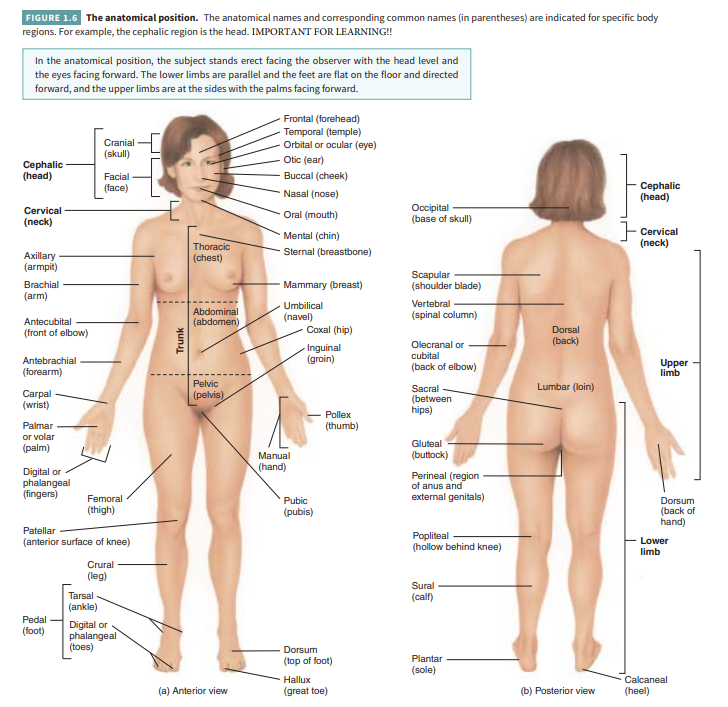
- cephalic (head)
- cranial (skull)
- frontal (forehead)
- temporal (temple)
- occipital (base of skull)
- facial (face)
- orbital or ocular (eye)
- cheek (buccal)
- otic (ear)
- nasal (nose)
- oral (mouth)
- mental (chin)
- cervical (neck)
- cranial (skull)
- upper limb
- axillary (armpit)
- scapular (shoulder blade)
- vertebral (spinal column)
- manual (hand)
- digital or phalangeal (fingers)
- dorsum (back of hand)
- palmar or volar (palm)
- pollex (thumb)
- carpal (wrist)
- olecranal or cubital (back of elbow)
- antecubital (front of the elbow)
- antebrachial (forearm)
- brachial (arm)
- inguinal (groin)
- thoracic (chest)
- mammary (breast)
- sternal (breastbone)
- umbilical (navel)
- trunk
- dorsal (back)
- lumbar (loin)
- pubic (pubis)
- perineal (region of anus and external genitals)
- gluteal (buttock)
- sacral (b/w hips)
- coxal (hip)
- lower limb
- femoral (thigh)
- patellar (anterior surface of knee)
- popliteal (hollow behind knee)
- crural (leg)
- sural (calf)
- pedal (foot)
- tarsal (ankle)
- digital or phalangeal (toes)
- dorsum (top of foot)
- hallux (great toe)
- plantar (sole)
- calcaneal (heel)
- 5 Principal regions are
- Regional Names
- define the anatomical planes, anatomical sections, and directional terms used to describe the human body.
- Directional terms
- superior = toward the head
- inferior = away from the head
- anterior = nearer to or at the front of the body
- posterior = nearer to or at the back of the body
- medial = closer to the midline (an imaginary vertical line dividing the body into equal right and left sides)
- lateral = farther from the midline
- intermediate = b/w 2 structures, e.g. the transverse colon is intermediate to the ascending and descending colons
- ipsilateral = on the same side of the body as another structure
- contralateral = on the opposite side of the body from another structure
- proximal = closer to the attachment of a limb to the trunk or origination of a structure
- distal = farther from the trunk or origination of a structure
- superficial = toward or on the surface of the body
- deep = away from the surface of the body
- superior = toward the head
- Planes and sections
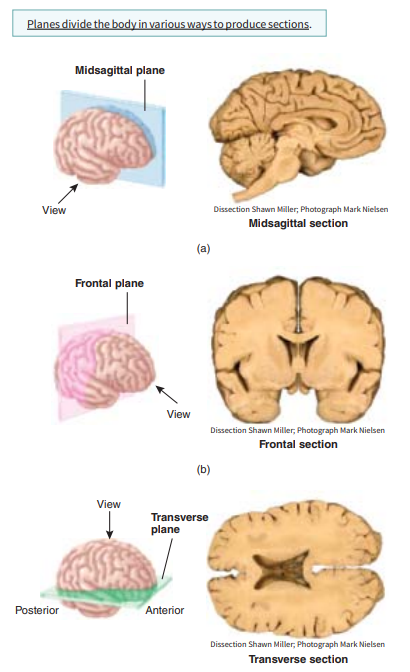
- A plane is an imaginary flat surfaces (passing thru the body parts) dividing the body or organ to visualize interior structures.
- Sagittal plane (a vertical plane dividing the body or an organ into right and left sides)
- Midsagittal plane (median plane) passes thru the midline of the body or an organ, dividing it into equal right and left sides.
- Parasagittal plane not passing thru the midline but instead dividing the body or an organ into unequal right and left sides
- Transverse plane (cross-sectional plane, horizontal plane; divides the body or an organ into superior aka upper and inferior aka lower portions)
- Frontal plane (coronal plane) divides the body or an organ into anterior (front) and posterior (back) portions
- Oblique plane passes thru the body or an organ at an oblique angle, not a right angle like sagittal, frontal, or transverse
- Section, a cut of the body or one of its organs made along a plane, after which they are named midsagittal, frontal, and transverse sections
- Directional terms
- outline the major body cavities, the organs they contain, and their associated linings.
- Body cavities
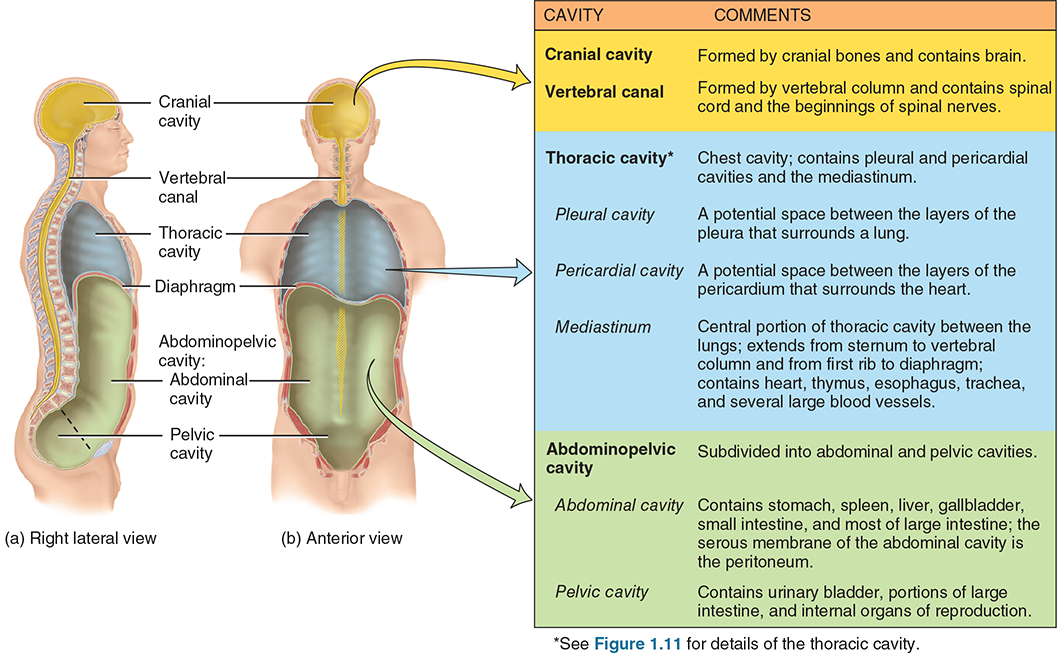
- Body cavities are spaces in the body that help enclosing (protect, separate, support) internal organs; separated by bones, muscles, ligaments and other structures
- Cranial cavity, a hollow space of the head formed by the cranial bones, contains the brain
- Vertebral canal, formed by the bones of the vertebral column (backbone); contains the spinal cord; continuous with the cranial cavity
- Meninges are 3 layers of protective tissues lining the cranial cavity and vertebral canal, surround the brain and spinal cord with a shock-absorbing fluid (cerebrospinal fluid)
- Organs inside the thoracic and abdominopelvic cavities are viscera
- Thoracic cavity, (chest cavity) formed by the ribs, the muscles of the chest, the sternum (breastbone), and the thoracic portion of the vertebral column; divided into
- the pericardial cavity (a fluid-filled space surrounding the heart)
- 2 fluid-filled spaces called pleural cavities each containing a lung
- Mediastinum is the central part of the thoracic cavity
- b/w the lungs, extending from the sternum to the vertebral column, from the 1st rib to the diaphragm;
- containing all thoracic viscera (heart, esophagus, trachea, thymus, and several large blood vessels to and from the heart) except the lungs
- Diaphragm, a dome-shaped muscle separating the thoracic cavity from the abdominopelvic cavity
- Abdominopelvic cavity, extends from the diaphragm to the groin, encircled by the abdominal muscular wall and the bones & muscles of the pelvis, divided into:
- Abdominal cavity contains the stomach, spleen, liver, gallbladder, small intestine and most of the large intestine
- Pelvic cavity containing urinary bladder, portions of the large intestine, and internal organs of the reproductive system
- Organs inside and thoracic and abdominopelvic cavities are called viscera
- Body cavities are spaces in the body that help enclosing (protect, separate, support) internal organs; separated by bones, muscles, ligaments and other structures
- A membrane is a thin, pliable tissue that covers, lines, partitions or connects structures, e.g. serous membrane
- slippery, double-layered membrane lining the wall of the thorax and abdomen,
- covering the viscera within the thoracic and abdominal cavities,
- not open directly to the exterior
- Pleura is the serous membrane of the pleural cavities
- Pericardium is the serous membrane of the pericardial cavity
- Peritoneum is the serous membrane of the abdominal cavity
- Retroperitoneal organs (posterior to the peritoneum)
- kidneys, adrenal glands, pancreas,
- duodenum of the small intestine,
- ascending and descending colons of the large intestine, and
- portions of the abdominal aorta and inferior vena cava
- Retroperitoneal organs (posterior to the peritoneum)
- Body cavities
- 2 Terms describing a reclining body:
- prone position where body lies facedown and
- supine position where body lies faceup
- Abdominopelvic regions & quadrants
- Abdominopelvic region, in anatomical studies, describe the location of abdominal and pelvic organs; 2 horizontal (subcostal thru the lowest level of 10th costal cartilages; transtubercular line thru the superior margin of the iliac crest of hip bone) and 2 vertical lines (left and right midclavicular line thru the midpoints of clavicles medial to nipples) partition the abdominopelvic cavity into 9 regions
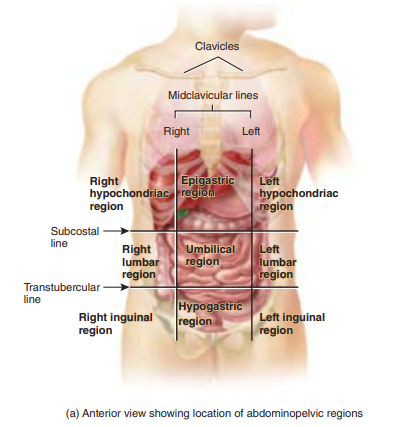
- right hypochondriac, epigastric (majority of liver), left hypochondriac,
- right lumbar, umbilical, left lumbar,
- right inguinal (iliac), hypogastric, left inguinal (iliac)
- Abdominopelvic quadrants, in clinical studies, locate the site of abdominopelvic abnormality; a midsagittal line (median line) and a transverse line (transumbilical line) crossing at the umbilicus divide the abdominopelvic cavity into quadrants (4)
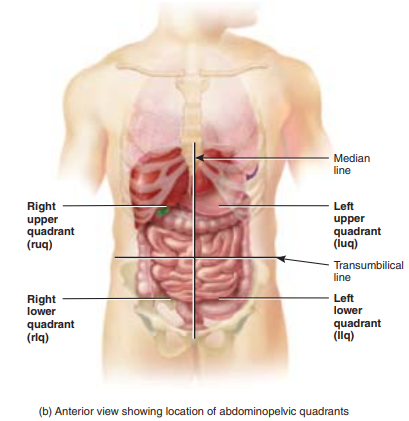
- right upper quadrant (RUQ),
- Left upper quadrant (LUQ, one of abdominopelvic quadrants where the kidney would be found)
- right lower quadrant (RLQ),
- left lower quadrant (LLQ)
- Abdominopelvic region, in anatomical studies, describe the location of abdominal and pelvic organs; 2 horizontal (subcostal thru the lowest level of 10th costal cartilages; transtubercular line thru the superior margin of the iliac crest of hip bone) and 2 vertical lines (left and right midclavicular line thru the midpoints of clavicles medial to nipples) partition the abdominopelvic cavity into 9 regions
- describe the anatomical position.